




In healthcare, access to oxygen is fundamental to patient care. From critical emergency interventions to everyday clinical treatments, oxygen systems must perform without interruption. That’s why Emergency Oxygen Supply Connections (EOSCs) are a vital component of facility infrastructure and an essential part of modern emergency preparedness strategies.
As healthcare environments face increasing regulatory requirements, system complexity, and demand variability, EOSCs help ensure continuity of care when it matters most.
In this article, we take a deeper look at these vital emergency gas systems, governing requirements, and the best places to start when planning for code compliance.
What Is an Emergency Oxygen Supply Connection—and Why Does It Matter?
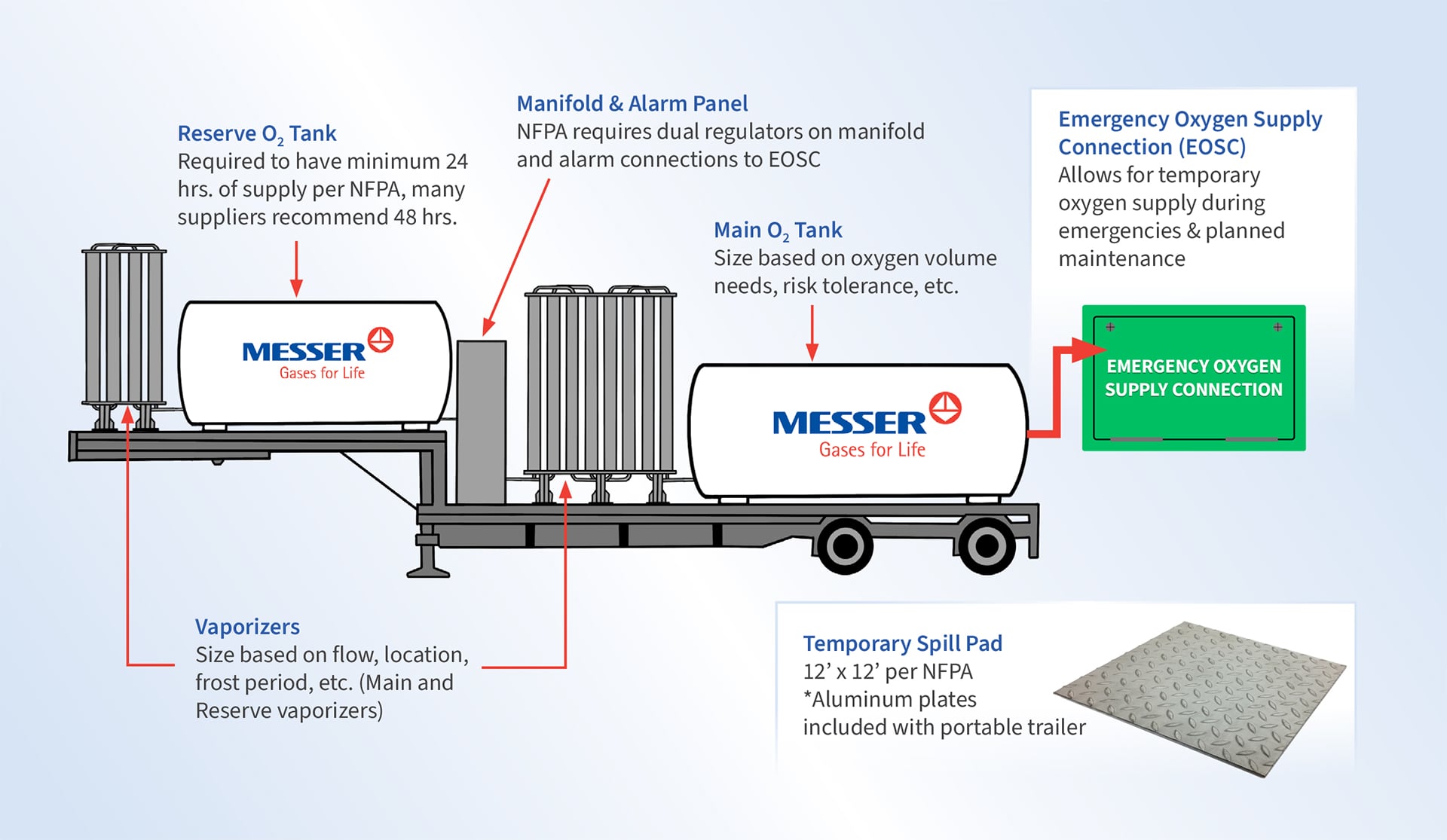
An EOSC is a dedicated connection point that allows a healthcare facility to temporarily receive oxygen from an external source in the event of an emergency or planned maintenance affecting the oxygen bulk system. Installed in accordance with NFPA (National Fire Protection Association) Code 99 (see additional governing codes below), an EOSC enables a medical gas supplier to connect a portable oxygen system directly to the facility’s main distribution line.
For healthcare facilities that rely on bulk oxygen and do not have a sufficient in-building reserve, EOSCs are essential. When properly designed and maintained, they allow suppliers to respond rapidly, helping avoid operational disruption and protect patient care.
Emergency Oxygen Supply Continuity During Emergencies and Maintenance
EOSCs play a critical role far beyond unexpected system outages. They are often used to support:
-
Emergency response to oxygen supply interruptions
-
Planned system maintenance or infrastructure upgrades
-
Facility expansions or oxygen-demand surges
Experienced medical gas suppliers work closely with healthcare teams to ensure EOSCs are properly located, accessible, and ready for use, so connections can be made efficiently when time is critical.
Codes and Standards That Govern EOSCs
EOSCs and temporary oxygen systems are governed by several critical codes, including:
-
NFPA 99: Health Care Facilities Code. Applies to healthcare facility medical gas systems and patient care risk
-
NFPA 55: Compressed Gases and Cryogenic Fluids Code. Applies to the storage, use, and handling of gases
-
CGA M-1: Standard for Medical Gas Supply Systems at Health Care Facilities. This standard from the Compressed Gas Association guides temporary medical gas supply systems so they can provide the same reliability as a permanent system and are aligned with applicable CGA M-1, NFPA 55, and NFPA 99 requirements.
Together, these standards help ensure that EOSCs and temporary oxygen systems can deliver similar levels of reliability, safety, and performance as permanent bulk systems, especially during emergency or maintenance situations.
Note: NFPA 99 and NFPA 55 also govern bulk, non-emergency medical oxygen systems. We take a deeper look at common NFPA compliance considerations here.
Keeping Pace with Evolving Codes and Best Practices
Industry standards continue to evolve, reflecting the importance of visibility and monitoring during emergency operations. Recent updates to NFPA 99 emphasize enhanced alarm integration, requiring EOSCs to include connections that allow temporary oxygen supplies to be connected to a facility’s master alarm panels.
Medical gas suppliers like Messer play an important role here. We help facilities understand new requirements, assess existing infrastructure, and identify upgrades that support long-term compliance and operational confidence.
Emergency Preparedness Is a Team Effort
An EOSC is most effective when it is part of a broader emergency preparedness strategy. Healthcare facilities are required to maintain detailed emergency operations plans that address essential utilities, including oxygen supply.
To support these plans, Messer maintains a dedicated fleet of portable oxygen trailers designed specifically for emergency and maintenance use. These temporary systems are engineered to function like permanent bulk installations and can be deployed quickly, helping facilities maintain oxygen flow during critical situations.
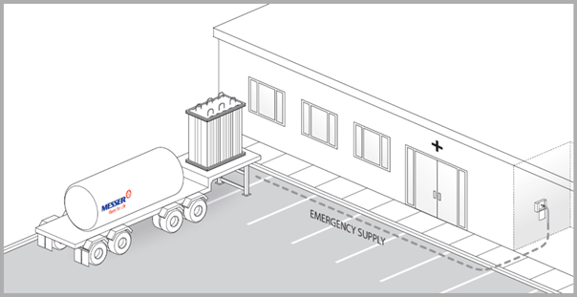
During periods of increased demand—such as public health emergencies—portable oxygen systems can play an important role in temporary supply planning when aligned with applicable code requirements.
Connecting Emergency Preparedness to a Resilient Oxygen Strategy
EOSCs are one part of a broader approach to oxygen system resilience. As we explored in our previous article, How to Rethink Your Bulk Medical Oxygen Strategy, maintaining a dependable oxygen supply goes beyond equipment alone. In that article, we look at how bulk oxygen suppliers with deep healthcare expertise can help simplify an increasingly complex process, working alongside healthcare organizations to strengthen planning, improve system design, and create a more resilient oxygen supply that supports both day-to-day operations and emergency response.
Emergency Oxygen Supply Connection Requirements: What Facilities Should Review Today
Proactive assessment is key to ensuring emergency systems perform as intended. Facilities should regularly review:
-
24/7 accessibility of EOSC for emergency supply & delivery vehicles
-
Required safety clearances for portable oxygen systems
-
Physical condition and security of EOSC components
-
Alignment with current NFPA and CGA requirements
Medical gas suppliers can support these reviews through site evaluations, compliance guidance, and coordination with facility teams—helping identify gaps before an emergency occurs.

Frequently Asked Questions About Emergency Oxygen Supply Connections
1. Are Emergency Oxygen Supply Connections required?
NFPA 99 requires medical gas and vacuum systems to include a point of access for connection of a temporary or supplemental source of supply. Facilities should review their systems with qualified medical gas professionals and the authority having jurisdiction to confirm current requirements apply.
2. What codes and standards apply to EOSCs?
EOSCs and temporary oxygen supply systems are commonly associated with NFPA 99, NFPA 55, and CGA M-1. These standards help guide medical gas system safety, emergency oxygen supply connections, cryogenic fluid handling, and healthcare facility gas supply requirements.
3. When would a healthcare facility use an EOSC?
A facility may use an EOSC during an oxygen supply interruption, planned maintenance, infrastructure upgrades, facility expansion work, or periods of unusual oxygen demand. The EOSC enables temporary oxygen supply equipment to support the facility while the primary system is unavailable or under strain.
4. What should facilities review to make sure an EOSC is ready for use?
Facilities should confirm that the EOSC is accessible 24/7, clearly identifiable, physically protected, secure, compatible with temporary oxygen equipment, and aligned with applicable NFPA 99, NFPA 55, and CGA M-1 requirements. They should also review required clearances, delivery vehicle access, alarm integration, emergency response procedures, etc.
5. How do alarm requirements affect EOSCs?
Recent NFPA 99 requirements emphasize the importance of monitoring temporary oxygen supply systems during use. EOSCs are required to have four alarm connection points installed to both master alarm panels to allow teams to monitor temporary supply status.
6. Who should be involved in EOSC planning and review?
EOSC planning should involve the responsible facility authority and qualified medical gas professionals. A supplier site audit can help review EOSC readiness, bulk oxygen system considerations, and alignment with applicable code requirements.
7. Can portable oxygen trailers be used with an EOSC?
Yes, when properly designed and connected, portable oxygen trailers or temporary oxygen systems can supply oxygen through an EOSC. These systems are often used during emergency response, planned maintenance, or temporary demand increases.

Comments
Messer makes no warranty of any kind with respect to the subject matter, the completeness, or accuracy of this blog. Messer is not responsible for any actions (or lack thereof) taken as a result of relying on or in any way using information contained in this blog. In no event shall Messer be liable for any damages resulting from reliance on or use of information in this blog. Readers should take advice from a qualified professional when dealing with specific situations. Descriptions of, or references or access to, other publications within this blog do not imply endorsement of those publications. This blog may contain technical inaccuracies and changes to the information may be made at any time.
Gas products are hazardous. The use or misuse of gas products involves serious risks, including injury, disability and death. Users of gas products must use the Safety Data Sheets for the gas products to warn their employees and others who are exposed to the gas products or hazards associated with such products.