Options for battery technologies and materials for the various applications from cars to drones to grid energy storage continue to grow.

From the mining and recycling of critical minerals to the production of electrode materials such as synthetic graphite, all the way to final battery assembly, and no matter the technology or material selected, the application of high purity, dependable and safe industrial gases remains a critical need for many steps of the manufacturing process.

Messer's industrial gases, supply systems, and safety experience support every step of the advanced battery supply chain, so you can achieve higher quality, safer operations, and greater sustainability.

Trust Messer for Dependable Gas Production and Supply Solutions

The list of battery technologies continues to evolve including, but not limited to: LFP (lithium iron phosphate), LCO (lithium cobalt oxide), LMO (lithium manganese oxide), NMC (lithium nickel manganese cobalt oxide), LiS (lithium-sulfur), and Sodium Ion batteries (a distinct class that uses sodium instead of lithium). Whether you’re producing materials, manufacturing cells, or scaling energy storage systems, Messer delivers the gas technologies and supply dependability you need to stay ahead.

Messer helps battery manufacturers with:

Required for battery-grade materials, precision cell and pack manufacturing. Messer engineers can help optimize gas use and purities to meet the production requirements with lowest total cost of ownership.

Through flexible gas supply modes, from cylinders and microbulk to bulk and onsite production and pipeline supply systems, tailored to your consumption levels and process requirements. Our solutions offer all scales of applications from R&D labs to Gigawatt scale battery materials and manufacturing facilities.

Our gas applications specialists understand the unique gas purity, safety, and process demands for battery materials manufacturing processes. We collaborate with customers to optimize the use of our gases for various applications such as atmosphere control, oxidation, inerting, purging, cooling and welding. All of which can have an impact on manufacturing line yield and productivity.

With custom gas production, storage and delivery systems, leak testing solutions, and safety support.

With dependable industrial gas supply and a nationwide distribution network that can keep your operations running 24/7, this is critical as you scale up (for new chemistries like the sodium-ion battery market or grid-storage manufacturing capacity).

Messer can provide opportunities for lowering Scope 2 and 3 emissions for manufacturers by exploring opportunities for renewable energy use in gases production as well as options for onsite gas production to eliminate emissions from gas distribution.

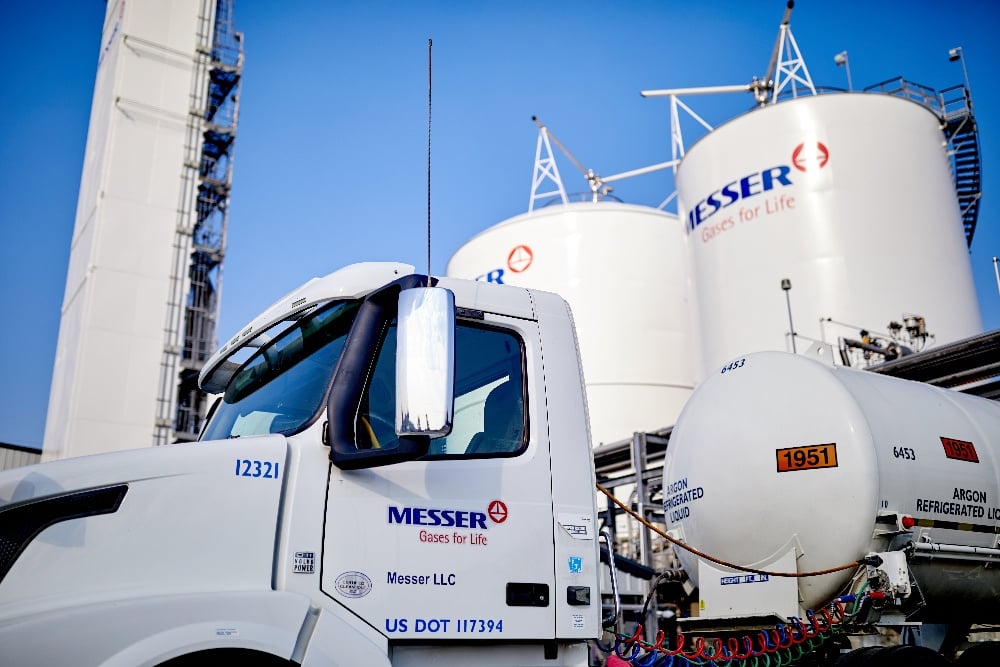
Use Messer for Your Argon Needs

Supporting the Entire Battery Manufacturing Supply Chain

Messer supplies high-purity specialty gases and other industrial gases essential to battery R&D and manufacturing, supporting calibration, analytical testing, and process control.
 
These gases provide accurate measurement, consistent product quality, safety, and traceability throughout every stage of the US battery materials supply chain, starting from extraction, processing and synthesis all the way to assembly and recycling.
Direct Lithium Extraction Icon for Battery Page

Mineral Extraction: Metal Recovery and Processing

Carbon dioxide is used for pH control and metal precipitation in hydrometallurgical extraction. CO₂ helps stabilize process conditions and supports efficient recovery of metals like nickel, cobalt, and lithium.

Nitrogen provides an inert atmosphere that prevents oxidation and contamination of reactive metals during extraction, ensuring safer and more consistent recovery.

Oxygen drives oxidation and leaching reactions that enhance metal separation and improve yield, increasing overall process efficiency and purity.

Battery Material Processing Refining

Material Processing: Refining, Drying and Precursor Treatment

Carbon dioxide helps regulate temperature and neutralize process effluents, improving control during refining and precipitation steps.

Nitrogen is used to blanket sensitive lithium and nickel compounds. It is also used to protect precursors from moisture and unwanted reactions during drying and storage.

Oxygen is essential in oxidation and calcination processes to form high-performance cathode materials with consistent crystal structures and composition.

Battery Components Anode Cathode and Electrolyt Mfg

Battery Components: Anode, Cathode, & Electrolyte Manufacturing

Argon provides an ultra-inert environment for coating, sintering, and assembling electrode materials of semi-precious metal powders, preventing oxidation and making sure of uniform film quality.

Nitrogen maintains a moisture- and oxygen-free environment during mixing, drying, and electrolyte preparation to preserve material stability. Needed for graphite anode production.

Oxygen supports precise oxidation steps needed to achieve optimal stoichiometry and electrochemical performance in cathode materials.

Battery Production Dry Room Ops Leak Detecion Cell Filling2

Battery Production: Dry Room Operations, Leak Detection, Cell Filling

Used for high-precision leak testing and detection in battery cells and modules, helium helps product integrity and long-term performance.

Creates and maintains dry, inert atmospheres in production areas to protect moisture-sensitive electrolytes and electrodes.

High-purity calibration and specialty gas mixtures — such as carbon monoxide (CO), carbon dioxide (CO₂), hydrogen (H₂), methane (CH₄), oxygen (O₂), argon (Ar), etc. play essential roles in maintaining process accuracy and product consistency. These gases are used for instrument calibration, gas chromatography, leak testing, and process monitoring, making sure of precise control, traceability, and compliance across every stage of the battery cell production process.

Battery Welding

System Assembly: Welding, Testing and Integration

Argon and carbon dioxide provide shielding gases for welding applications, resulting in clean, high-strength joints in battery housings, battery terminal connectors, and battery enclosures.

Nitrogen is used for purging, pressurizing, and testing systems to verify leak-tightness and maintain inert conditions during assembly.

Oxygen supports combustion and testing operations in controlled conditions to validate safety and performance of assembled systems.

Battery Recyling and End of Life

Battery Recycling and End-Of-Life Supply Chain Solutions

Carbon dioxide to recycle EV batteries is used for process cooling, neutralization, and carbonation reactions to safely manage heat and byproducts during material recovery.

Serves as a reducing agent to recover valuable metals from black mass, enabling cleaner and more efficient recycling.

Nitrogen is used for inerting processes to prevent fires or explosions when handling mized materials with reactive battery residues and fine powders. 

Oxygen facilitates oxidation and refining steps to separate and purify recovered materials for reuse in new battery production.

For plant construction: Messer provides Ar/CO₂, fuel gases, N₂, and O₂ for welding, commissioning, and fabrication.

Any questions?

Ask our team. We’re here to help.


Contact Us