





If you walk the perimeter of most hospitals, you will find a fenced-in yard containing one or two large white tanks, some vaporizers, and piping. That equipment is likely the bulk oxygen system, which provides medical-grade oxygen fundamental for patient care.
These systems can often be overlooked as the hospital continues to expand, and it's not uncommon for them to become deficient. Understanding relevant regulatory requirements is critical for anyone involved in their safety, compliance, and operation.
After years of reviewing medical oxygen systems at hospitals across the country, the Messer medical gas team tends to find similar deficiencies. These issues can stem from hospitals expanding around an oxygen yard, using landscaping designs unaware of what's behind the fence, or repairing concrete pads with the wrong materials. Although unintentional, these deficiencies can be a cause for safety concerns, and many are preventable or easily remedied.
In this article, we share some of our most common observations on deviations from the NFPA (National Fire Protection Association) codes for bulk medical oxygen systems, with a particular focus on site and location issues. Along the way, we provide the relevant code references so your team can conduct a walk-through and assessment.
Get our guide to bulk medical oxygen system compliance here
NFPA Oxygen Storage Requirements
Requirements for bulk oxygen systems in the healthcare environment are mainly governed by two NFPA codes:
-
NFPA 55: Compressed Gases and Cryogenic Fluids Code. This code governs where and how a bulk oxygen system can be installed.
-
NFPA 99: Health Care Facilities Code. This code governs the performance and reliability of the bulk oxygen system as a piece of medical infrastructure.
Hospital facility stakeholders should recognize that the reliability and redundancy requirements included in these codes make the difference between an oxygen system and a medical oxygen system. Both are critical. NFPA 55 keeps the installation safe; NFPA 99 keeps it reliable.
Below, we focus specifically on critical safety and compliance considerations for outdoor bulk oxygen systems, the liquid oxygen (LOX) installations that supply the hospital's medical gas pipeline (this article will not cover cylinder storage rooms or in-building piping).
NFPA 55 Bulk Oxygen Systems Requirements
NFPA 55 covers a variety of items directly related to the safe operation of a medical oxygen system, including:
-
Separation distances from buildings, sidewalks, parked vehicles, combustibles, etc.,
-
Required surface materials for pad equipment anchoring and delivery vehicle offloading
-
Spill protection at fill connections
-
Signage
-
Vehicle protection
-
Means of egress(s) from enclosures
NFPA 99 Bulk Oxygen Systems Requirements
NFPA 99 requirements are designed to provide for a robust oxygen system that is resistant to operational and supply disruptions. Core requirements include:
-
Reserve supply capacity
-
Alarm requirements
-
Emergency Oxygen Supply Connection (EOSC)
NFPA Enforcement: Governing Authorities
The NFPA does not directly enforce the requirements outlined above. The Authority Having Jurisdiction (AHJ) is responsible for code enforcement. Depending on your state or facility, the AHJ might be:
-
The state or local fire marshal
-
An accrediting body like The Joint Commission (TJC) or Det Norske Veritas (DNV)
-
The Centers for Medicare & Medicaid Services (CMS)
-
The local building official
-
HCAI or OSHPD (California only)
AHJs are not necessarily mutually exclusive, and some geographies may face overlapping jurisdictions. Notably, the adopted edition of NFPA 55 and NFPA 99 also varies from state to state. Due to important differences between editions, we recommend that you always confirm which edition your AHJ or state has adopted before planning a project.
Your facility will benefit from taking the time to understand these requirements before you begin a project because many common deficiencies are easy to correct. It can be expensive to correct after a fire marshal cites you, but catastrophic if a real incident happens first. The examples below will help illustrate the practical tools and visual cues needed to spot many of these issues during your own walk-throughs.
Common Site and Location Issues for Hospital Bulk Oxygen Systems
Site and location issues are some of the most frequently cited deviations from NFPA standards that our team encounters. You need an experienced partner who understands the relevant code requirements to help guide you through potential solutions to deficiencies.
Safety Separation Distances
NFPA 55 requires bulk oxygen systems to maintain strict separation distances from anything that could become a hazard if exposed to oxygen enrichment, ignition, or impact. Common violations fall into a handful of categories:
-
Less than 50 feet from combustible buildings (Type III, IV, or V construction). This issue is relatively common and can be one of the hardest to fix, because hospitals tend to expand toward their bulk oxygen yard over time. A tank that was 60 feet from the nearest building in 1995 can be 30 feet from a new wing built in 2020.
-
Less than 10 feet from public sidewalks or property lines.
-
Less than 50 feet from areas with non-ambulatory patients: patient care areas, recovery rooms, anywhere a fire or oxygen incident would put people who can't evacuate themselves at risk.
Insufficient distance from combustible or flammable liquid storage tanks. Hospitals may have large diesel tanks for their emergency generators. These are frequent causes of violations, especially on older campuses where the generator yard and the oxygen yard are next to each other.
There is one critical nuance that can be easy to miss: distance requirements apply to the uninsulated portions of equipment. For this reason, your distances may not be what you think they are.
Fire barrier walls are sometimes used as a workaround for distance violations, but they're easy to apply incorrectly, and they aren't permissible in every situation. If a wall is being used to satisfy a distance requirement, we recommend having the design reviewed by someone who understands the code requirements well.
Code references: NFPA 55 Table 9.3.2; NFPA 55 Section 9.3.2.
Courtyard and Recessed Areas
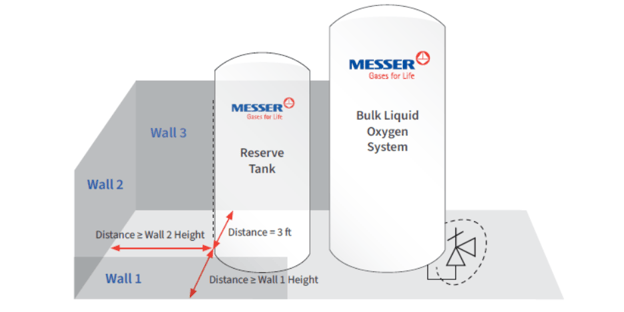
Courtyard clearances: distance from each wall must be at least equal to that wall's height.
Because this requirement is geometric and not reducible to a single measurement, it can be harder to notice safety separation distances. Many hospitals like to build walls around their tanks to keep them out of sight, but when a bulk oxygen tank is enclosed on three or more sides by walls (a "court," in NFPA 55 language), additional clearance rules take effect.
Oxygen is denser than air, meaning that walls can trap it. A leak or a vent in a three-sided courtyard doesn't dissipate the way it would in open air. If the oxygen pools, the local atmosphere becomes oxygen-enriched, and ordinarily safe materials may become flammable.
The most common hospital scenarios our team encounters include:
-
A tank installed in a tight service alcove between wings of the building
-
A recessed yard between two tall structures with a third wall behind it
-
An open site that transformed into a “court” when a new addition went up
Poor ventilation in these geometries can increase oxygen enrichment risk, and it is one of the hardest deficiencies to remediate because the fix usually involves either knocking down a wall or moving the tank.
Code references: NFPA 55 Section 3.3.28 (definition of "Court"); Table 8.6.2; Section A.8.12.2.7.2.
Combustible Materials and Site Cleanliness
This deficiency may be fixed quickly, because it is usually about housekeeping, not design. NFPA 55 requires that combustible materials be kept at least 15 feet from oxygen equipment. That includes:
-
Grass, weeds, and mulch
-
Fallen leaves and accumulated debris
-
Cardboard, trash, and storage bags
-
Wooden pallets, plastic crates, or other staged materials
- Vegetation that has grown up to or through the equipment over time
In an ordinary outdoor environment, that debris is benign. In an oxygen-enriched environment, after a small leak from a fitting overhead, those same leaves can ignite from a static spark, the impact of a tool dropped on the concrete, or even a hot bearing.
Debris collecting at the base of oxygen tanks and around piping is a frequent finding during fire marshal inspections. Simple best practices like a quarterly walk-around with a leaf blower and a trash bag will resolve most common site cleanliness issues. It is important to note that NFPA allows for small, well-maintained vegetation around the perimeter of a bulk oxygen station.
Code references: NFPA 55 Section 9.3.2.1; NFPA 55 Section 7.1.10.3 (Clearance from Combustibles and Vegetation); NFPA 55 Section A.7.1.10.3.
Concrete Pads and Surface Materials
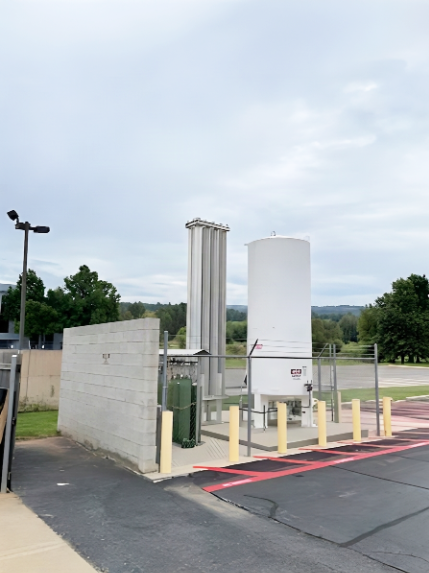
A poor design choice: combustible paint covering the concrete spill pad.
The surface under and around a bulk oxygen system must be noncombustible. This requirement may appear obvious, but many older installations exhibit issues such as:
-
Asphalt under the tank or fill area. Asphalt is a petroleum product and undergoes reactions with liquid oxygen that result in dangerous conditions.
-
Concrete painted with combustible coatings. A well-meaning maintenance team paints the pad to make it look fresh and inadvertently creates a combustible surface.
-
Concrete repaired with organic crack fillers or sealants. This is one of the most common findings. The pad itself is compliant, but a contractor may have patched a crack with the wrong product, creating a strip of combustible material running across the spill zone.
Why are these issues important? Liquid oxygen, when spilled, can soak into organic materials. An oxygen-saturated piece of asphalt or crack filler can become combustible. Ignition energies that are normally trivial (a static discharge, a steel tool dropped on concrete) become more than enough to set it off.
The rule is straightforward: only noncombustible concrete and cementitious repair materials are acceptable. If your concrete pads need repair, specify the patching material explicitly and don't let it get value-engineered down to a cheaper organic product. If you're not sure what's under your tanks today, find out before your next inspection.
Code references: NFPA 55 Section 16.4.1.2; Section 9.2.2; Section 16.4.3; Section 11.4.1.1.3.
Other NFPA Bulk Oxygen Storage and Operations Requirements
Beyond the illustrative site and location issues discussed above, facilities will need to review how the system is protected from physical hazards, whether required backup and emergency connections are in place, and whether routine inspection and operational requirements are being consistently documented.
Physical Protection and Layout
Bulk oxygen systems must be protected from foreseeable physical hazards and arranged to support safe operation and emergency access. Key considerations include liquid oxygen spill protection at fill connections, barriers or bollards where vehicle impact is possible, adequate spacing around system components, and a secondary means of egress from enclosed equipment areas.
System Performance and Emergency Connections
NFPA 99 requirements focus on maintaining oxygen availability during equipment failures, delivery interruptions, and other emergencies. Facilities should confirm that required reserve supply capacity is available, the Emergency Oxygen Supply Connection (EOSC) is accessible and functional, and alarm and monitoring systems are configured to provide timely notice of low supply, abnormal pressure, or system failure.
Signage, Inspections, and Daily Operations
Some of the most preventable deficiencies involve routine requirements that are overlooked over time. Missing or damaged signage, incomplete annual inspection records, and inconsistent daily checks can all create compliance concerns. Establishing clear ownership for inspections, documentation, and routine walk-throughs can help keep small issues from becoming repeated findings.
Moving Toward a Stronger Culture of Compliance
A proactive review of your bulk oxygen system can help identify deficiencies before they lead to citations, costly remediation, operational disruption, or risks to patient safety. Some issues can be corrected through routine maintenance or better documentation. Others require coordinated planning, system modifications, or a deeper understanding of how NFPA requirements apply to the installation.
That’s why working with a knowledgeable, hands-on medical gas provider can be so valuable. A provider familiar with hospital oxygen systems can help your team assess existing conditions, plan for facility expansions or system upgrades, and address compliance concerns without compromising the reliability of a critical patient care resource.

Frequently Asked Questions
1. Which NFPA codes govern hospital bulk oxygen systems?
Hospital bulk oxygen systems are primarily governed by NFPA 55 and NFPA 99. NFPA 55 addresses the safe installation and operation of bulk oxygen systems, while NFPA 99 focuses on the performance and reliability requirements that apply to medical oxygen infrastructure.
2. Who enforces NFPA requirements for hospital oxygen systems?
NFPA requirements are enforced by the applicable Authority Having Jurisdiction (AHJ). Depending on the facility and location, this may include a state or local fire marshal, building official, accrediting organization, the Centers for Medicare & Medicaid Services, or another governing authority. Facilities should confirm which editions of NFPA 55 and NFPA 99 their AHJ has adopted.
3. How are safety separation distances measured for bulk oxygen equipment?
NFPA 55 separation distances generally apply to uninsulated portions of the system. For example, the outer wall of an insulated oxygen vessel may not be the relevant measurement point, while an uninsulated vaporizer may be. Facilities should identify the applicable equipment components before evaluating clearances.
4. What requirements apply when a bulk oxygen system is located in a courtyard?
When a bulk oxygen system is enclosed by walls on three or more sides, NFPA 55 may classify the space as a court. The distance from each wall must be at least equal to the height of that wall, with a minimum clearance of 1 foot at the closest point. These requirements help address both structural hazards and the risk of oxygen accumulating in a poorly ventilated area.
5. How far should combustible materials be kept from oxygen equipment?
NFPA 55 requires combustible materials to be kept at least 15 feet from oxygen equipment. This can include weeds, mulch, fallen leaves, cardboard, wooden pallets, plastic crates, and accumulated debris. Small, well-maintained vegetation may be permitted around the perimeter of a bulk oxygen station.
6. What surface materials are acceptable around a bulk oxygen system?
Surfaces beneath and around bulk oxygen equipment should be noncombustible. Asphalt, combustible coatings, and organic crack fillers or sealants can create hazards if exposed to liquid oxygen. Concrete pads should be maintained with appropriate cementitious repair materials.
7. What other bulk oxygen system requirements should facilities review?
Facilities should also review liquid oxygen spill protection, vehicle-impact barriers, equipment spacing, enclosure egress, reserve supply capacity, Emergency Oxygen Supply Connection accessibility, alarm and monitoring systems, required signage, annual inspection records, and routine operational checks. Clear responsibility for these reviews can help prevent recurring compliance deficiencies.

Comments
Messer makes no warranty of any kind with respect to the subject matter, the completeness, or accuracy of this blog. Messer is not responsible for any actions (or lack thereof) taken as a result of relying on or in any way using information contained in this blog. In no event shall Messer be liable for any damages resulting from reliance on or use of information in this blog. Readers should take advice from a qualified professional when dealing with specific situations. Descriptions of, or references or access to, other publications within this blog do not imply endorsement of those publications. This blog may contain technical inaccuracies and changes to the information may be made at any time.
Gas products are hazardous. The use or misuse of gas products involves serious risks, including injury, disability and death. Users of gas products must use the Safety Data Sheets for the gas products to warn their employees and others who are exposed to the gas products or hazards associated with such products.